
For years I logged every workout in an app. Every set, every rep, every pound. At the end of each one I’d tap finish, glance at a summary, and put my phone away.
What did all that logging do for my next workout? Nothing, really. The numbers just sat there. If I wanted to know whether something was working, I’d have to scroll back through my history and piece it together myself. I rarely did that. My bet is that most people don’t. So they end up logging for logging’s sake.
Despite the fact that I was logging without any real purpose, I kept doing it. Partially out of habit and partially out of some weird feeling that if I didn’t log it, it didn’t count.
I sort of wanted something better for myself, and to be honest, AI and LLMs were what unlocked it for me. So I started building Trainlike.
The one thing that doesn’t wear off
Most of the strength training app category is built to keep you interested / engaged not necessarily to make you stronger. There’s good reason for some of it. Gym apps have notoriously high churn…think along the lines of gym membership and you get the idea. Some apps hand you a new workout every week. Others hand you likes, gamified badges and a streak to protect. Heck, even Trainlike has streak counts and a strength score…but thankfully, I stopped before badges 🤷🏻♂️.
That stuff is fine and it works for a while. But the novelty eventually wears off and you’re left with a log that remembers everything and says nothing. You outgrow the likes and badges pretty quick. And the program churn gets annoying.
There is, however, one thing in your training that gets more valuable the longer you keep at it, and it is your own record. It just needs something to read it.
A day I read wrong
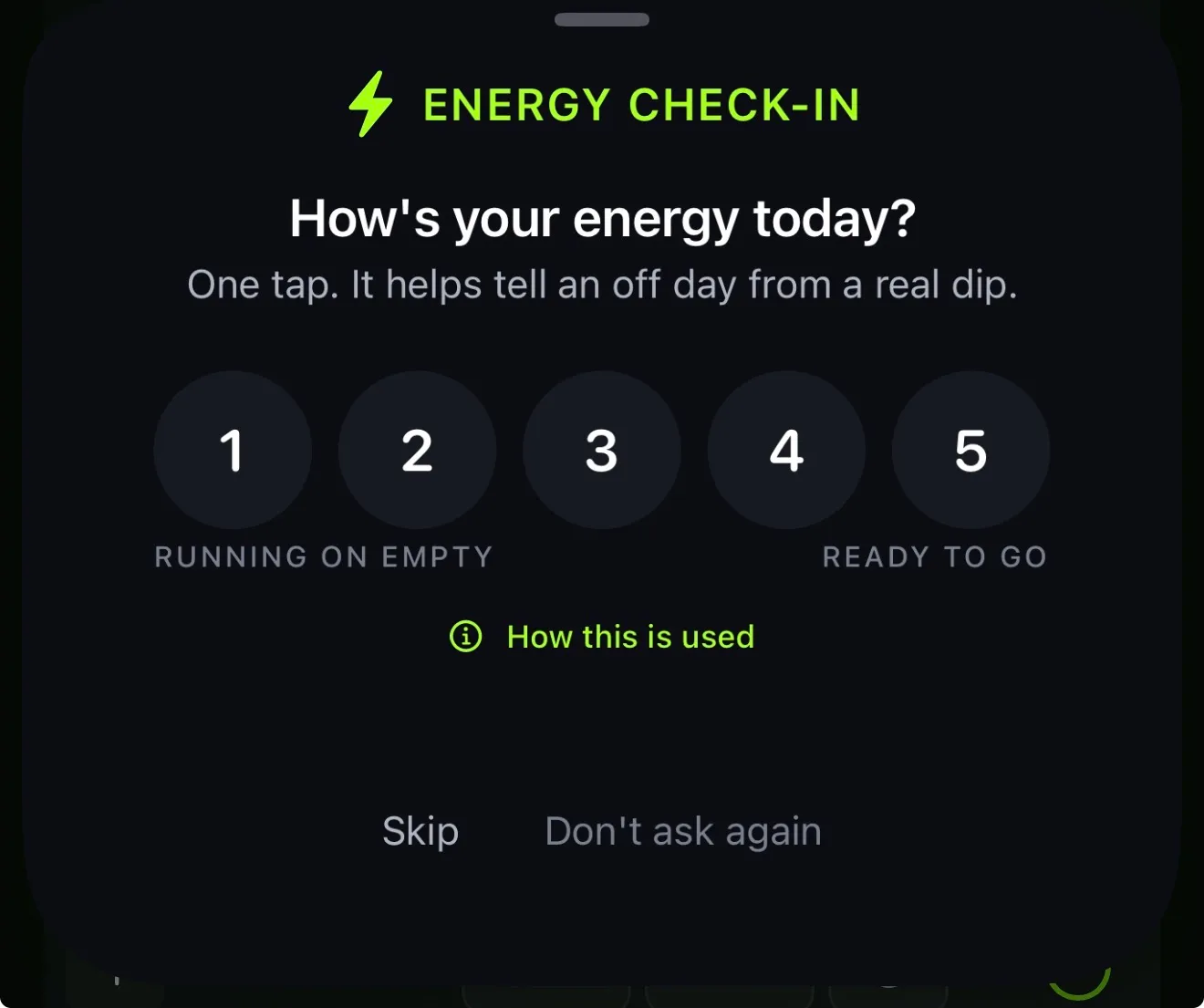
Recently I did a back workout on a day I had nothing in the tank, and I said so in the app before I started (there’s an energy check-in when you start each workout). I got through it, and if you’d asked me afterwards I’d have called it a so-so day.
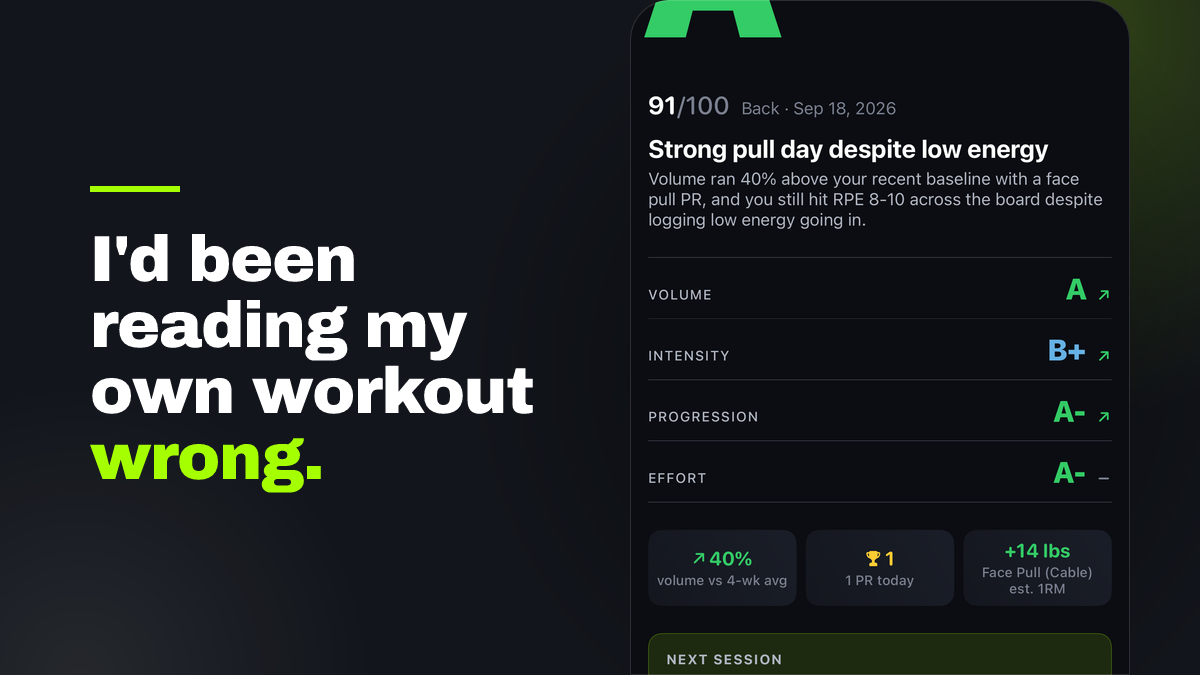
The post workout breakdown disagreed. The grade was an A minus, which surprised me, but the useful part was underneath it. Volume was about 40% above my recent average. I’d hit a PR on face pulls. My effort had held at RPE 8 to 10 the whole way through, on a day I’d logged as low energy.
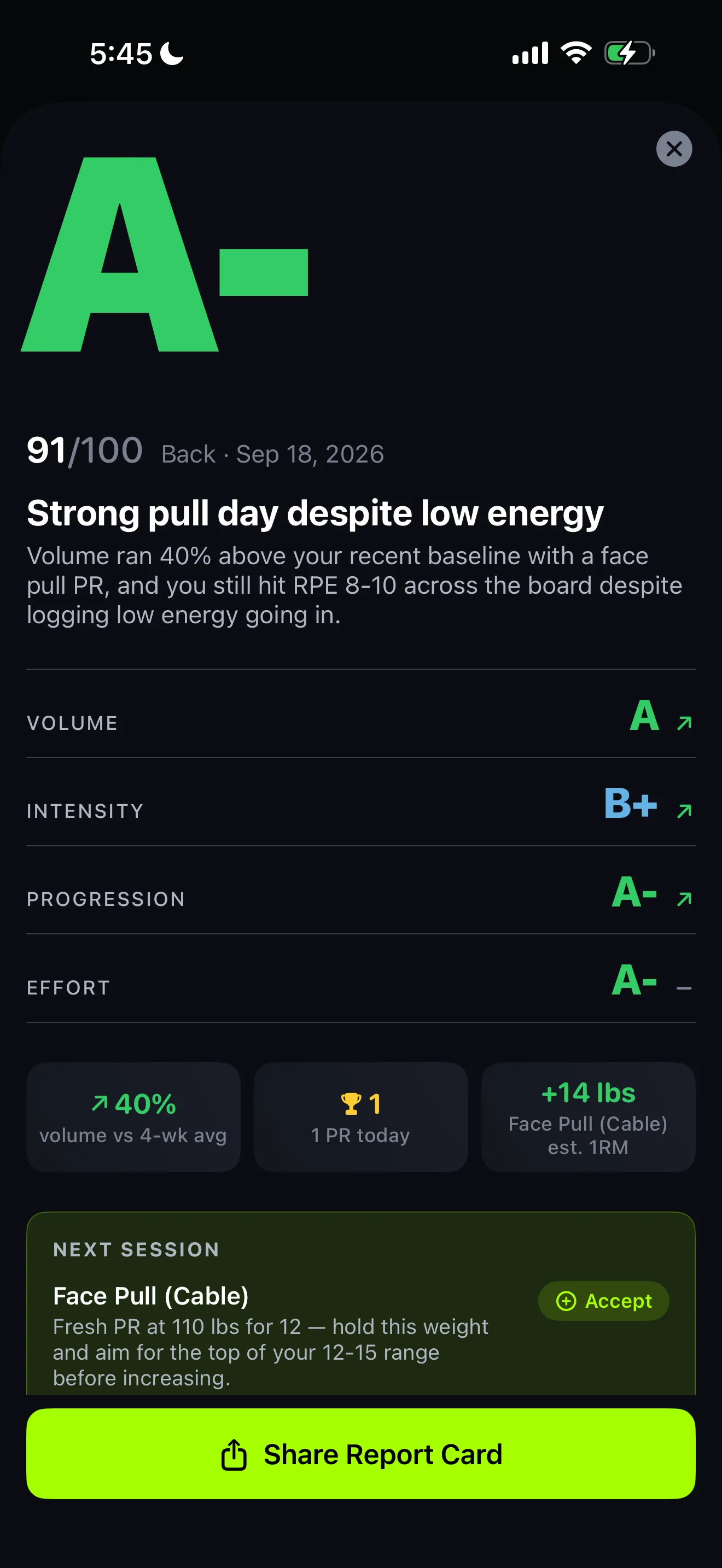
The headline it wrote was “Strong pull day despite low energy.” I’d been reading my own workout wrong.
Then the recommendation for my next session…Hold the face pulls at 110 pounds and work toward the top of my 12 to 15 range before adding weight. One tap to accept, and the next time I open that workout the target is already sitting there. I don’t have to remember any of it.
Ok, let me draw out a distinction here. Trainlike has two things going on inside that determine how it progresses your next workout.
- Deterministic progressive overload engine (POE). A fancy algorithm (math) that looks at your prior workouts, preferred rep scheme, preferred rep ranges, etc and sets what your next target should be. It looks a lot like double progression with some smarter back off etc built in.
- AI insights that break down your workout after the fact to determine your next targets. Basically a whole bunch of workout metrics get pre-computed then an AI will run a deeper analysis taking into account things like your energy level, injuries (if noted), your goals, body weight, etc. I loathe to call it a coach…but yeah sort of like an AI coach…but not a chatbot and not annoying.
So here’s the small difference it made for one exercise. For my next face pull session, the POE would have prescribed 110 * 13, 110 * 13, 110 * 12, 110 * 12. You can see from the image this makes sense given a simple progression.
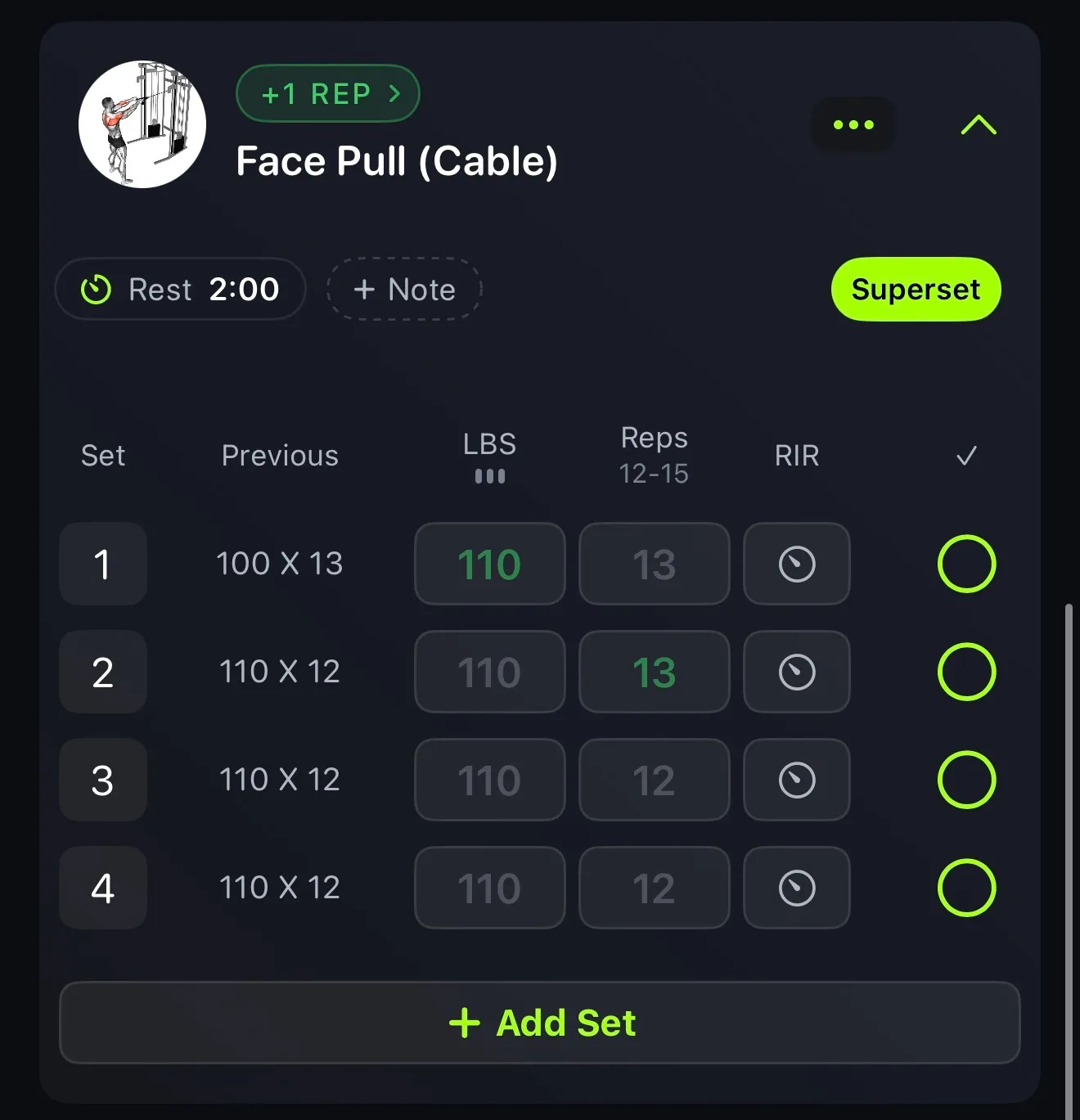
The AI breakdown told me to go straight to 110 * 13 for all 4 sets. Yep, that was a better and more appropriate goal / progression for my next Face Pull workout. Why? It saw the fresh PR at 110 and told me to hold the weight and push toward the top of my 12-15 range. The math said +1 rep. The breakdown saw the PR and moved all four sets to 13.
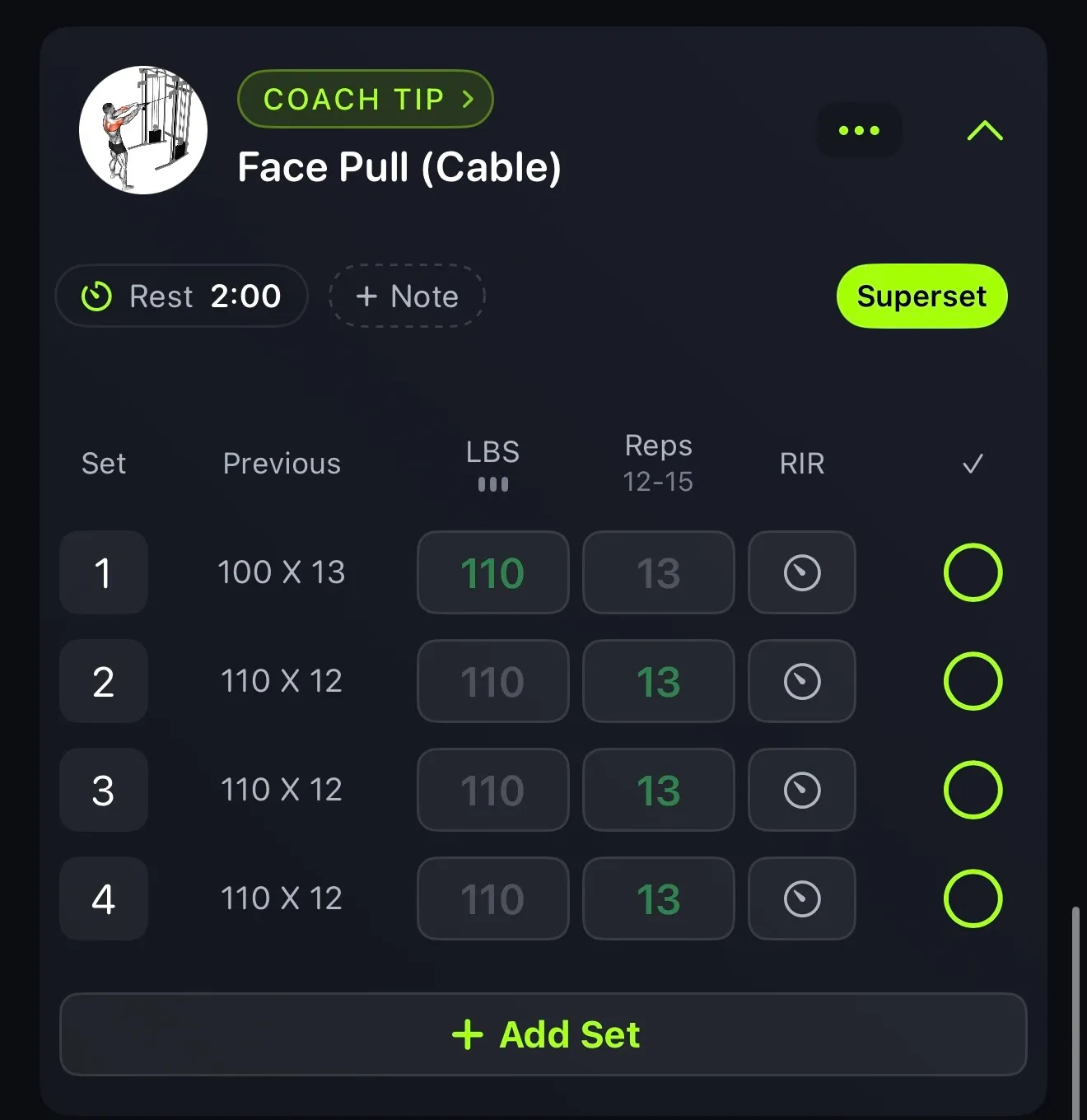
You might say that is a tiny difference of two reps total. You’d be right. But that’s a single exercise from a single workout. The insights are there for every workout, every exercise across all your days. The idea is to get you stronger, faster when it makes sense to do so.
So for me, this was my app using my training history, goals, energy, etc to make a recommendation. I didn’t have to guess at what I should aim for next time and it is more personalized than what a formula is going to spit out every time.
And the nice thing about the way it’s built into the system. You ‘approve’ the AI recommendations each time so nothing is a surprise. So if you don’t like what it has to say, just let the math (POE) do its thing.
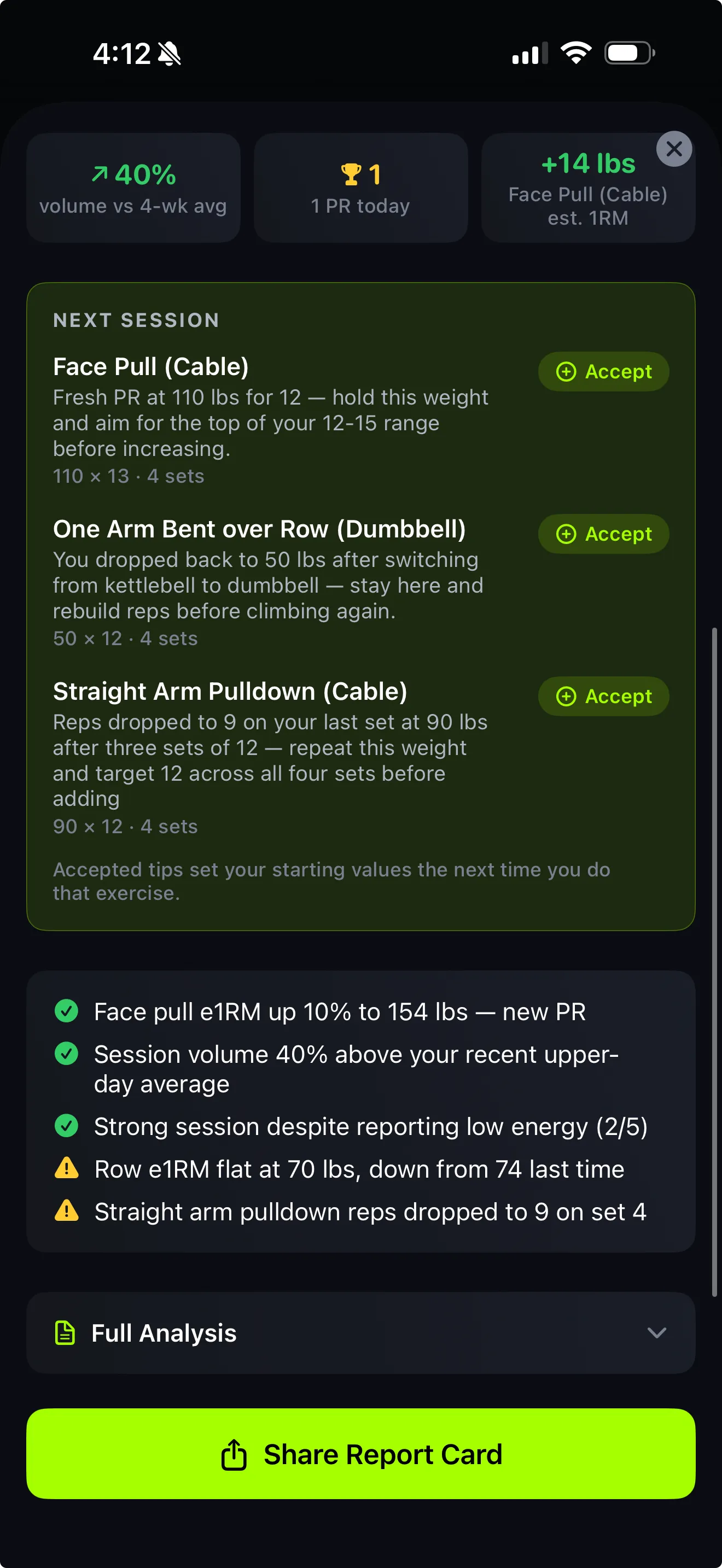
You’ll notice in the screenshot above there is also a drop down for a full analysis that provides summary and write up of trends, strengths, and areas to improve for that workout.
Some people won’t care about this level of detail. Personally, I wanted to feel a bit more connected to my progress. I wanted to be able to make sense of my workouts, my data and the recommendations that the black box is giving me. If that’s not your thing, fair enough.
I think the fitness app industry as a whole is moving towards turning data into understanding for its customers. I recently came across an article from Jason Stoffer that brought this home for me:
Measurement is a wedge, not a destination.
His point is that scores on their own get less interesting over time, and the value is in closing the loop from measurement to action.
That’s what I’m trying to do with Trainlike.